

Labral tear of the hip
Classification of Labrum Lesions
Labrum lesions can be categorized according to their location and severity as follows:
- Partial labrum lesion: Partial tears or damage to the labrum, which often remain localized.
- Complete labrum lesion: Complete detachment or destruction of the labrum, often associated with joint instability.
- Traumatic labrum lesion: Caused by accidents or sudden impacts, e.g., during falls.
- Degenerative labrum lesion: Caused by age-related wear or chronic stress.
Causes of labrum lesions
The main causes of labrum lesions can be divided into several categories:
- Misalignments of the hip joint: Hip dysplasia or femoroacetabular impingement (FAI) increase the risk.
- Athletic overuse: Intensive movements in ballet, martial arts, or soccer.
- Traumatic injuries: Falls or direct blows to the hip.
- Osteoarthritis: Degenerative changes in the hip joint.
Symptoms of labrum lesion
The symptoms vary depending on the severity of the injury, but often include:
- Pain in the groin or lateral hip area.
- Clicking or snapping during hip movements.
- Instability and uncertainty when walking or running.
- Movement restrictions, especially during rotational movements.
Diagnosis of labrum lesion
The diagnosis is made through a combination of medical history, clinical examination, and imaging techniques:
- **Medical History:** The doctor inquires about the exact location of the pain, the mechanism of the accident, and the symptoms.
- **Clinical Examination:** Specific tests, such as the FADIR test or FABER test, help identify labrum injuries.
- **Imaging Techniques:**
- **MRI:** High-resolution imaging of the labrum and possible accompanying injuries.
- **X-ray:** Exclusion of bony misalignments or osteoarthritis.
- **CT Arthrography:** Precise imaging of the labrum through contrast medium examination.
Treatment options for labrum lesions
Conservative Therapy
In less severe cases, a labrum lesion can be treated conservatively:
- Physiotherapy: Exercises to stabilize and strengthen the surrounding muscles.
- Medication Therapy: NSAIDs for pain relief and anti-inflammatory effects.
- Rest: Avoidance of strenuous activities that overstrain the joint.
- Injections: Cortisone injections to reduce inflammation and pain.
Surgical Therapy
In severe or therapy-resistant labrum lesions, surgery is necessary:
- Arthroscopic Labrum Repair: Minimally invasive procedures to reattach or smooth the labrum.
- Labrum Reconstruction: Replacement of the damaged labrum with the body's own or artificial material.
- Stabilizing Procedures: Additional procedures to restore joint stability, e.g., in cases of misalignment.
Preventive measures for labrum lesions.
To prevent labrum lesions, the following measures are recommended:
- Regular muscle training: Strengthening the muscles to stabilize the joint.
- Avoiding overstrain: Limiting intense sports activities or taking timely breaks.
- Warming up before sports: Mobilization and stretching to prepare the joint for stress.
- Correct movement patterns: Proper execution of movements in sports and daily life to avoid incorrect loading.
- Protection against injuries: Using appropriate protective clothing in high-risk sports.
Iliopsoas shortening
The iliopsoas shortening describes a shortening of the iliopsoas muscle, which consists of the psoas major muscle and the iliacus muscle. This muscle complex is the main flexor of the hip joint and plays an important role in stabilizing the spine. A…
Coccygodynia/tailbone pain
Coccygodynia, also known as tailbone pain, refers to chronic pain in the area of the coccyx (os coccygis). These complaints often occur when sitting, during bowel movements, or during physical activities and can significantly affect the quality of…
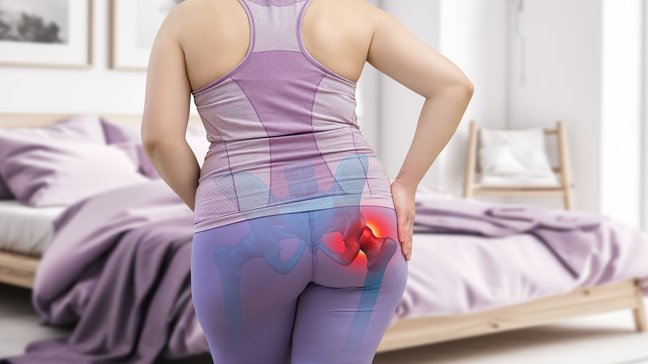
Avascular necrosis of the femoral head
Avascular necrosis of the hip, medically also referred to as femoral head necrosis, describes the death of bone tissue in the femoral head due to impaired blood supply. This condition often occurs between the ages of 30 and 50 and affects men more…
Labral tear of the hip
Classification of Labrum Lesions
Labrum lesions can be categorized according to their location and severity as follows:
- Partial labrum lesion: Partial tears or damage to the labrum, which often remain localized.
- Complete labrum lesion: Complete detachment or destruction of the labrum, often associated with joint instability.
- Traumatic labrum lesion: Caused by accidents or sudden impacts, e.g., during falls.
- Degenerative labrum lesion: Caused by age-related wear or chronic stress.
Causes of labrum lesions
The main causes of labrum lesions can be divided into several categories:
- Misalignments of the hip joint: Hip dysplasia or femoroacetabular impingement (FAI) increase the risk.
- Athletic overuse: Intensive movements in ballet, martial arts, or soccer.
- Traumatic injuries: Falls or direct blows to the hip.
- Osteoarthritis: Degenerative changes in the hip joint.
Symptoms of labrum lesion
The symptoms vary depending on the severity of the injury, but often include:
- Pain in the groin or lateral hip area.
- Clicking or snapping during hip movements.
- Instability and uncertainty when walking or running.
- Movement restrictions, especially during rotational movements.
Diagnosis of labrum lesion
The diagnosis is made through a combination of medical history, clinical examination, and imaging techniques:
- **Medical History:** The doctor inquires about the exact location of the pain, the mechanism of the accident, and the symptoms.
- **Clinical Examination:** Specific tests, such as the FADIR test or FABER test, help identify labrum injuries.
- **Imaging Techniques:**
- **MRI:** High-resolution imaging of the labrum and possible accompanying injuries.
- **X-ray:** Exclusion of bony misalignments or osteoarthritis.
- **CT Arthrography:** Precise imaging of the labrum through contrast medium examination.
Treatment options for labrum lesions
Conservative Therapy
In less severe cases, a labrum lesion can be treated conservatively:
- Physiotherapy: Exercises to stabilize and strengthen the surrounding muscles.
- Medication Therapy: NSAIDs for pain relief and anti-inflammatory effects.
- Rest: Avoidance of strenuous activities that overstrain the joint.
- Injections: Cortisone injections to reduce inflammation and pain.
Surgical Therapy
In severe or therapy-resistant labrum lesions, surgery is necessary:
- Arthroscopic Labrum Repair: Minimally invasive procedures to reattach or smooth the labrum.
- Labrum Reconstruction: Replacement of the damaged labrum with the body's own or artificial material.
- Stabilizing Procedures: Additional procedures to restore joint stability, e.g., in cases of misalignment.
Preventive measures for labrum lesions.
To prevent labrum lesions, the following measures are recommended:
- Regular muscle training: Strengthening the muscles to stabilize the joint.
- Avoiding overstrain: Limiting intense sports activities or taking timely breaks.
- Warming up before sports: Mobilization and stretching to prepare the joint for stress.
- Correct movement patterns: Proper execution of movements in sports and daily life to avoid incorrect loading.
- Protection against injuries: Using appropriate protective clothing in high-risk sports.
Iliopsoas shortening
The iliopsoas shortening describes a shortening of the iliopsoas muscle, which consists of the psoas major muscle and the iliacus muscle. This muscle complex is the main flexor of the hip joint and plays an important role in stabilizing the spine. A…
Coccygodynia/tailbone pain
Coccygodynia, also known as tailbone pain, refers to chronic pain in the area of the coccyx (os coccygis). These complaints often occur when sitting, during bowel movements, or during physical activities and can significantly affect the quality of…
Avascular necrosis of the femoral head
Avascular necrosis of the hip, medically also referred to as femoral head necrosis, describes the death of bone tissue in the femoral head due to impaired blood supply. This condition often occurs between the ages of 30 and 50 and affects men more…