

Developmental monitoring in childhood
Why is a development check useful?
Children's bodies are constantly growing. Minor deviations can self-correct – sometimes, however, early orthopedic evaluation is important.
An examination can help:
• Detect postural abnormalities early
• Assess growth disorders in a timely manner
• Prevent musculoskeletal problems
• Accompany your child's physical development
What is checked during the examination?
During the orthopedic developmental check-up, various areas of the musculoskeletal system are assessed.
These include, among others:
• Spine – e.g., round back, scoliosis, or postural deviations
• Leg axis – assessment of knock-knees or bowlegs and axis deviations
• Foot development – e.g., overpronation with fallen arches or flatfoot
• Gait – assessment of movement and coordination
• Motor development – age-appropriate movement patterns
When is a check particularly useful?
An orthopedic developmental check-up can be particularly useful during important growth phases.
For example:
• at kindergarten age
• before starting school
• during the growth spurt in puberty
• with noticeable posture or complaints
Benefits of an early examination
An early examination makes it possible to detect abnormalities in time and treat them in a targeted manner.
• early diagnosis of possible misalignments
• targeted guidance for parents and children
• timely physiotherapeutic measures
• support for healthy physical development
An examination is particularly advisable during important growth phases or when parents notice abnormalities in posture, gait pattern, or mobility.
No. The developmental check-up is a preventive examination and can be useful even without symptoms to detect potential problems at an early stage.
The examination is conducted in a playful and child-friendly manner. Posture, mobility, spine, legs, and feet are assessed.
Usually, the examination takes about 15 to 20 minutes.
Not always. Many childhood irregularities resolve on their own. If necessary, targeted exercises or physiotherapy may be recommended.
The earlier possible misalignments are detected, the easier they are to treat and the better the musculoskeletal system can develop.

Posture, Stability, and Mobility Analysis with Medi Mouse
The Medi Mouse is a modern measuring instrument for the analysis of the spine. With this method, posture, mobility, and stability of the spine can be examined precisely—entirely without X-ray radiation.
The examination provides important information…

Pediatric orthopedics
Pediatric orthopedics is a specialized area of orthopedics that deals with the diagnosis, treatment, and prevention of diseases and deformities of the musculoskeletal system in children and adolescents. This discipline takes into account the special…
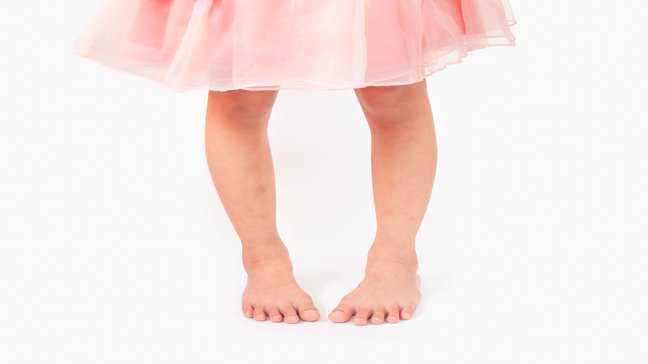
Desalineaciones en niños
Misalignments of the legs, such as knock-knees (genu valgum) and bowlegs (genu varum), are common observations in children. These deviations from the normal leg axis can be both physiological and pathological and affect the development and mobility…
Developmental monitoring in childhood
Why is a development check useful?
Children's bodies are constantly growing. Minor deviations can self-correct – sometimes, however, early orthopedic evaluation is important.
An examination can help:
• Detect postural abnormalities early
• Assess growth disorders in a timely manner
• Prevent musculoskeletal problems
• Accompany your child's physical development
What is checked during the examination?
During the orthopedic developmental check-up, various areas of the musculoskeletal system are assessed.
These include, among others:
• Spine – e.g., round back, scoliosis, or postural deviations
• Leg axis – assessment of knock-knees or bowlegs and axis deviations
• Foot development – e.g., overpronation with fallen arches or flatfoot
• Gait – assessment of movement and coordination
• Motor development – age-appropriate movement patterns
When is a check particularly useful?
An orthopedic developmental check-up can be particularly useful during important growth phases.
For example:
• at kindergarten age
• before starting school
• during the growth spurt in puberty
• with noticeable posture or complaints
Benefits of an early examination
An early examination makes it possible to detect abnormalities in time and treat them in a targeted manner.
• early diagnosis of possible misalignments
• targeted guidance for parents and children
• timely physiotherapeutic measures
• support for healthy physical development
An examination is particularly advisable during important growth phases or when parents notice abnormalities in posture, gait pattern, or mobility.
No. The developmental check-up is a preventive examination and can be useful even without symptoms to detect potential problems at an early stage.
The examination is conducted in a playful and child-friendly manner. Posture, mobility, spine, legs, and feet are assessed.
Usually, the examination takes about 15 to 20 minutes.
Not always. Many childhood irregularities resolve on their own. If necessary, targeted exercises or physiotherapy may be recommended.
The earlier possible misalignments are detected, the easier they are to treat and the better the musculoskeletal system can develop.
Posture, Stability, and Mobility Analysis with Medi Mouse
The Medi Mouse is a modern measuring instrument for the analysis of the spine. With this method, posture, mobility, and stability of the spine can be examined precisely—entirely without X-ray radiation.
The examination provides important information…
Pediatric orthopedics
Pediatric orthopedics is a specialized area of orthopedics that deals with the diagnosis, treatment, and prevention of diseases and deformities of the musculoskeletal system in children and adolescents. This discipline takes into account the special…
Desalineaciones en niños
Misalignments of the legs, such as knock-knees (genu valgum) and bowlegs (genu varum), are common observations in children. These deviations from the normal leg axis can be both physiological and pathological and affect the development and mobility…